Thursday, October 16, 2008

Global poverty

There's a big news story today that no one is covering. The story is that much of the world is living in poverty.

In 1987, the U.N. designated today, October 17, as International Day for the Eradication of Poverty. While the New York Times covers how much Barak Obama is spending on ads, and CNN covers a new archaeological site in Rome, I can't find a blip today about poverty on their web sites. I bet I know which story is more important to the billions of people wondering what they're going to eat today. (At least the BBC wrote something.)

To give you a sense of the situation, are a few statistics:
  • There are about 6.7 billion people in the world.
  • About half of those people live on less than $2.50/day.
  • 26,500-30,000 children die each day due to poverty (source). You think school shootings are bad? Try annihilating two or three average-sized elementary schools—every hour.
  • 1 in 6 people in the world are illiterate (source).
  • 2.6 billion people lack basic sanitation.
  • 1.1 billion people have inadequate access to water.
Excluding China, things have improved some, but not much, over the past few decades:

(Image from Anup Shah, Poverty Facts and Stats, GlobalIssues.org. Used with permission under a Creative Commons license.)

If you're reading this post, chances are that you're not part of the population that we're talking about. The fact that you have electricity and internet access bumps you out of that group. However, that means that you probably also have a lot of capacity to help.

Christ taught that "unto whomsoever much is given, of him shall be much required". This principle certainly applies to both you and me as individuals, as well as the countries where we live. We have a lot to do as a world. People and countries that are well off (that's you!) have a responsibility to help those who are struggling.

The way that we help is important, because some help actually hurts. For example, food aid can actually cause more problems than it solves, since it can depress prices below what local farmers can compete with. (Agricultural subsidies in developed nations have the same effect.) The result is that instead of having local farmers supply nutritional needs and build the local economy, the farmers are themselves forced into poverty and their country becomes even more dependent on foreign aid. Real solutions must be sustainable.

As part of Poverty Day today, the U.N. released a book called Turning Rhetoric into Action. Its motto, "With us not for us", is a good summary of how to make real progress.

So how do we solve this problem? I'm not an expert, but it seems like these things might help:
  • Reduce barriers to trade for poor countries. Providing a broader market for poor people to sell their wares would cost us little and help them a lot.
  • Get rid of farm subsidies. Artificially pricing one of the most viable economic activities in developing nations out of the game just isn't cool.
  • Help people in developing nations learn how to lift themselves out of poverty. We can't just do it for them, or else things will return to how they were when we leave. People and nations need to become self-sufficient.
  • Relieve debt for poor countries. This would free up resources spent financing debt for more productive uses.
"OK," you might say, "but what can I do? I can't just eliminate tariffs by myself or forgive Madagascar's debt." True. Fighting poverty requires big changes that no one can effect alone. However, you can still help. Spread the word. If everyone knew and cared about this issue, things would change. Contribute to organizations that promote sustainable solutions to world problems. Influence the legislative process to promote helpful policies and laws. Pray for change—and then do something.

For more information on Poverty Day:
(As a side note, the U.S. doesn't do so hot with poverty at home, either. Fourty percent of us have been below the poverty line in the last ten years, and around 15% are currently below the line.)

Wednesday, October 15, 2008

Technology and the Church

I'm a member of The Church of Jesus Christ of Latter-day Saints, so I've followed with interest the Church's adoption of technology to help it accomplish its mission. The Church has used computers for years to keep track of financial and membership information in wards and branches, and it first set up shop (er, church) on the internet in 1996.

Things have come a long way in the last few years. Today, the Church's web site is useful, easy to use, and well designed. You can view ward directory information online, and mormon.org is a great resource for sharing our beliefs with the world.

Joel Dehlin became the Church's Chief Information Officer in 2004, and a lot of good things have happened since then. The Church's web sites have been redesigned, and they now both work and look better than before. A new, more capable graphical program for managing unit information has been deployed, replacing the ancient DOS-based program that had been in use for over a decade. The recently unveiled maps.lds.org site is a great way to locate a place to attend church.

Of course, there's still lots of work to do. For example, it would be great if I could view and report on my home teaching assignment online, or if leaders could view an interactive map that shows where each ward member lives. I would love it if I could subscribe to a feed that automatically showed church relevant church events on my calendar. I spent some time as a missionary in working in the mission office, and there's tons of room for technology to help out there.

I was happy to discover today that the Church is reaching out to the technology community through its LDS Tech web site. They're sharing what they're working on, soliciting feedback and help with the Church's technology projects, and working to develop some of the missing features mentioned above. Some of the projects on the site are a new home and visiting teaching application and a system for managing mission offices.

One of the coolest sections of the site is the LDS Tech Wiki, where people with technical skills can contribute to unfinished projects. If you have design, programming, editing, or other skills, and you're looking for a great place to put them to work, take a look.

Sometimes I worry that spending so much of my time studying and developing technology isn't the best way to contribute to the world. It's encouraging to see that technology is being used by the Church (and others) to accomplish great good in the world. I'm excited to see what the future brings.

Tuesday, October 14, 2008

Kleptocracy

I learned the word kleptocracy today. Here's the context:
Last year Ghana struck oil for the first time off its coast. But the Ghanaians, wiser after their descent from high hopes to kleptocracy, kept their celebrations muted and are now inviting the Norwegians in to advise them on how to exploit their windfall sensibly.
(The rest of the article, "Opportunity Knocks", is really good, by the way. Take a look if you're interested in Africa.)

A kleptocracy is a government that advances the interests of a small group at the expense of the general population. Ghana is in that boat, as it is "some 30 times poorer in wealth per person" than it was when it gained independence in 1957, despite its plentiful natural resources.

Saturday, October 11, 2008

Canyoneering in Baptist Draw (again)

This Thursday and Friday I went on a field trip with my canyoneering class. I took the same class last year, and this field trip was really similar to last year's field trip. We went to the San Rafael Swell in eastern Utah. We did Ding and Dang canyons on Thursday, which are easy, non-technical slots. Yesterday we did Baptist Draw and Upper Chute.

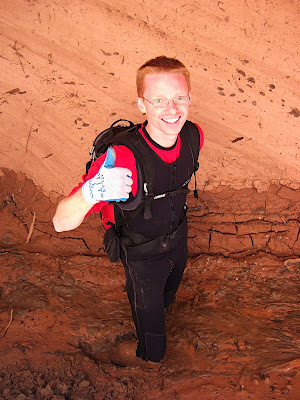
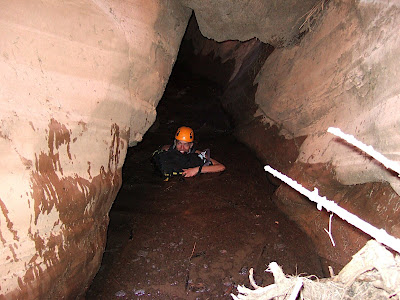
Baptist Draw was a lot of fun. There are a lot of cool people in our class, and the canyon was in great condition. The weather was a little cool while waiting at the "big" (80-foot) rappel, but it was perfect for most of the time. There was just one puddle in Baptist Draw, but the hike became a mudfest once we got into Upper Chute. There was one wade up to my chest, and most of the rest were thigh-deep or less. The recent water didn't smell too bad, and it had mixed with the fine dirt to make creamy, smooth, chocolatey mud. It was a lot of fun!

Here are some pictures and a video. You can see more in the full gallery.

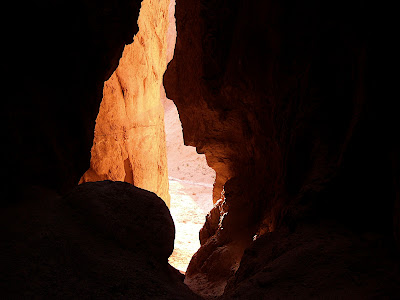
Mudstone formation near our campsite

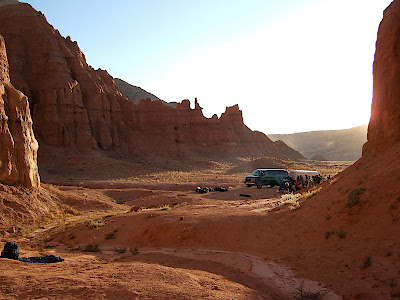
Campsite near Goblin Valley

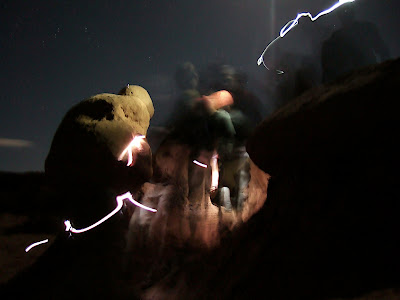
Playing Sardines in the dark at Goblin Valley

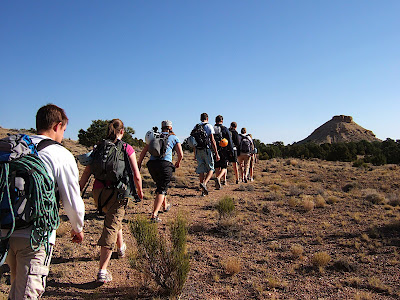
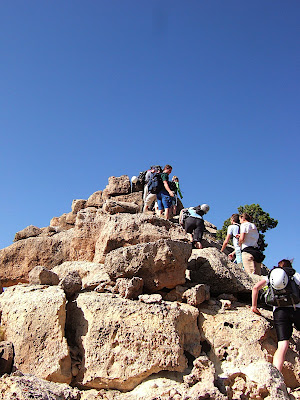
Hiking toward Teepee Rock to get to the canyon the next morning

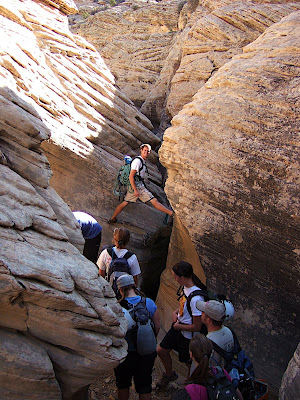
Kyle hanging out above the first obstacle in Baptist Draw (a little pothole), waiting for the traffic jam to subside

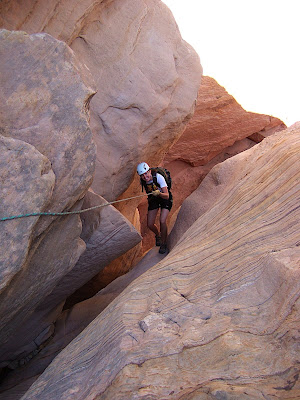
Camille at the end of Baptist Draw, rappelling 80 feet down to the floor of Upper Chute Canyon

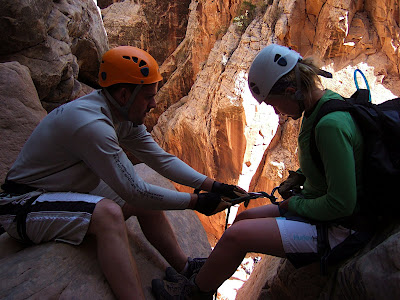
Tristan helping Janni get set up for the rappel

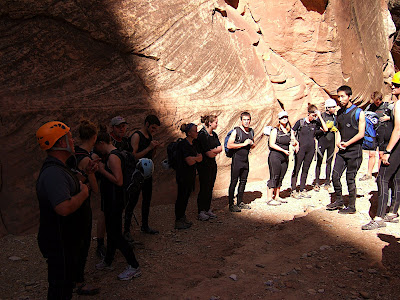
All suited up, ready to enter the mudfest

It was a really muddy mudfest. :)

Adam swimming through some pristine water

Video of us playing in the mud

Kenna drinking some chocolate milk


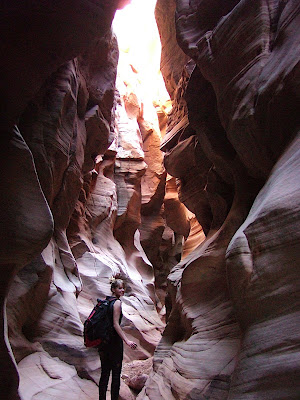
I love these narrows!

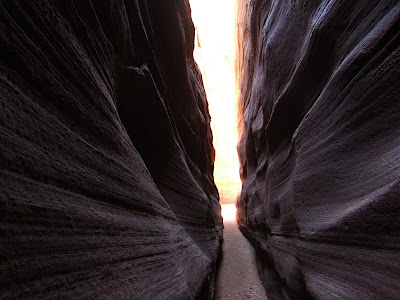
Straight, skinny slot right before our exit. (As a side note, this looks strangely like the rock equivalent of a snow formation that I saw while climbing Lone Peak last winter.)

Hiking back up to the canyon rim

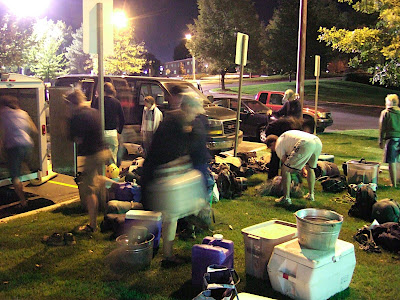
Back in Provo, putting away our mountain of gear